Music Box Wagner Ride of the Valkyries

Price: €8.09
SKU SU-05 Category Music Boxes

Music Box — Wagner's Ride of the Valkyries

Turn the crank of this small mechanical music box and you hear one of classical music's most recognizable melodies: the "Ride of the Valkyries" from Richard Wagner's operatic cycle The Ring of the Nibelung. Wagner composed this monumental work beginning in 1848, drawing on Germanic mythology and the heroic epic of the Nibelungs. The piece that plays here opens the third act of the second opera in the cycle, Die Walküre (The Valkyrie), and its dramatic, surging character has made it a fixture in Western culture for nearly two centuries.

The Composition and Its History

The "Ride of the Valkyries" stands among Wagner's most performed and recognizable works. Its stirring orchestration and mythological subject matter gave it a complex cultural legacy. The piece was incorporated into Nazi-era newsreels and propaganda, a historical fact that remains deeply controversial, particularly in Germany and Israel. Later, it appeared in the 1979 anti-war film Apocalypse Now, where its use underscored the chaos and violence of warfare—a stark reversal of its earlier propagandistic function.

How It Works

The music box operates via a hand-turned crank that drives a mechanical pinned cylinder, which plucks the tuned metal tines of a comb. The mechanism itself is mounted on a small wooden board. When left inside the decorated cardboard box alone, the melody sounds delicate and contained. However, the wooden board's design allows the mechanism to resonate more powerfully when pressed against a larger surface—a table, chair, or percussion instrument like a cajón—which amplifies the sound naturally and fills a room with fuller tone.

Construction and Materials

The box combines cardboard, metal, and wood in a compact format. The wooden resonance board is integral to the sound-amplification principle: the vibrations of the metal comb transfer efficiently into the wood, which then radiates the sound outward. This is a practical application of acoustic physics built into a portable object.

What's Included

  • One complete music box with crank mechanism and wooden resonance board
  • Decorated cardboard housing

Playing and Listening

Operation requires no skill or musical knowledge. Simply insert the crank and turn it at a steady, moderate pace. The melody will play through once per full rotation. The speed of your turning does not significantly alter the pitch, though a very slow turn may cause the mechanism to skip. For best results, hold the box firmly or place it on a solid surface while cranking, then press the wooden board against a resonating body to hear the full character of the melody.

A Collector's and Educational Object

This music box serves multiple purposes: as a historical curiosity documenting mechanical music technology, as a reference object for classical music education, and as a portable reminder of one of opera's most iconic moments. Its compact size makes it suitable for display, travel, or demonstration in educational settings where the mechanics of hand-cranked sound production merit attention.

The Valkyries' dramatic entrance remains a touchstone of Western operatic tradition, and this mechanical version preserves one of Wagner's most enduring melodies in a form that has delighted listeners for generations.


Price: €8.09
SKU SU-05 Category Music Boxes

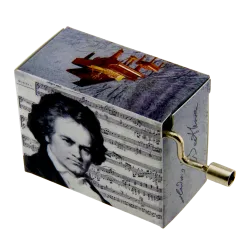
Music Box Wagner Ride of the Valkyries — This German mechanical music box plays the dramatic overture from the third act of *Die Walküre*, one of the most recognisable compositions in classical music. Compact (8.6 × 4.8 × 3.1 cm), it combines a crank mechanism with a wooden resonance board to naturally amplify the melody. Wagner's portrait engraved on the casing adds a historical dimension to it. Ideal for classical music collectors, educational demonstrations of mechanical instruments, or simply to relive this epic moment from the opera in a portable format. A fragment of the *Ring of the Nibelung* within reach.

Origin Germany
Weight 0,07 kg
Dimensions 8,5 × 4,5 × 3,0 cm
Materials Cardboard - Metal - Wood
Category Classical music
Audio Samples
Wagner - Ride of the Valkyries

Caution: Not suitable for children under 3 years. Please supervise older children. Beware of swallowing small parts, strangulation, material allergies, sharp edges and points! Use only for sound generation. No liability for improper use.

Care: Extreme temperature fluctuations, humidity and direct sunlight can affect the lifespan. Please store in balanced humidity to prevent material changes, mold and corrosion. Remove dirt with a damp cloth. Dry after cleaning and each use.

Disposal: Please contact your local waste disposal authority for information on environmentally sound disposal!

Cet instrument vous a touché ? Faites-le découvrir.

La musique du monde se transmet — partagez cette découverte.

Music Box — Wagner's Ride of the Valkyries

Turn the crank of this small mechanical music box and you hear one of classical music's most recognizable melodies: the "Ride of the Valkyries" from Richard Wagner's operatic cycle The Ring of the Nibelung. Wagner composed this monumental work beginning in 1848, drawing on Germanic mythology and the heroic epic of the Nibelungs. The piece that plays here opens the third act of the second opera in the cycle, Die Walküre (The Valkyrie), and its dramatic, surging character has made it a fixture in Western culture for nearly two centuries.

The Composition and Its History

The "Ride of the Valkyries" stands among Wagner's most performed and recognizable works. Its stirring orchestration and mythological subject matter gave it a complex cultural legacy. The piece was incorporated into Nazi-era newsreels and propaganda, a historical fact that remains deeply controversial, particularly in Germany and Israel. Later, it appeared in the 1979 anti-war film Apocalypse Now, where its use underscored the chaos and violence of warfare—a stark reversal of its earlier propagandistic function.

How It Works

The music box operates via a hand-turned crank that drives a mechanical pinned cylinder, which plucks the tuned metal tines of a comb. The mechanism itself is mounted on a small wooden board. When left inside the decorated cardboard box alone, the melody sounds delicate and contained. However, the wooden board's design allows the mechanism to resonate more powerfully when pressed against a larger surface—a table, chair, or percussion instrument like a cajón—which amplifies the sound naturally and fills a room with fuller tone.

Construction and Materials

The box combines cardboard, metal, and wood in a compact format. The wooden resonance board is integral to the sound-amplification principle: the vibrations of the metal comb transfer efficiently into the wood, which then radiates the sound outward. This is a practical application of acoustic physics built into a portable object.

What's Included

  • One complete music box with crank mechanism and wooden resonance board
  • Decorated cardboard housing

Playing and Listening

Operation requires no skill or musical knowledge. Simply insert the crank and turn it at a steady, moderate pace. The melody will play through once per full rotation. The speed of your turning does not significantly alter the pitch, though a very slow turn may cause the mechanism to skip. For best results, hold the box firmly or place it on a solid surface while cranking, then press the wooden board against a resonating body to hear the full character of the melody.

A Collector's and Educational Object

This music box serves multiple purposes: as a historical curiosity documenting mechanical music technology, as a reference object for classical music education, and as a portable reminder of one of opera's most iconic moments. Its compact size makes it suitable for display, travel, or demonstration in educational settings where the mechanics of hand-cranked sound production merit attention.

The Valkyries' dramatic entrance remains a touchstone of Western operatic tradition, and this mechanical version preserves one of Wagner's most enduring melodies in a form that has delighted listeners for generations.

Recently viewed

Comments (0)
No customer reviews for the moment.

You might also like