Music Box Arabesque
Music Box Arabesque
This small mechanical music box plays a delicate melody through the interaction of metal tines and a rotating cylinder — a direct descendant of 18th-century automata that brought music into homes before electric amplification existed. The Arabesque music box produces crystalline, nostalgic tones by plucking metal lamellae as the mechanism turns, a method that remains mechanically elegant and entirely acoustic.
Sound and Resonance
The music box generates sound at a modest volume by default. To increase audible intensity, remove the box from its printed cardboard sleeve and press it gently against a resonant surface — a table, shelf, or wooden box — while operating the mechanism. This transfers vibration to a larger surface area, allowing the tones to project more effectively into the room. The principle is acoustic rather than electronic: the vibrating metal tines couple their energy to the resonance body, which then radiates sound more efficiently.
Construction and Materials
The music box is built from cardboard, metal, and wood in a compact format. The printed cardboard exterior serves both protective and decorative functions, while the internal mechanism relies on metal components and wooden structural elements to house and drive the tine-striking apparatus. This combination of materials is typical of portable mechanical music boxes designed for domestic use and travel.
Visual Design
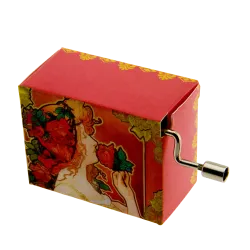
The exterior decoration reproduces Gustav Klimt's painting "The Kiss," a prominent work from early 20th-century Viennese art. The pairing of this visual motif with the mechanical music-making creates a synthesis of visual and auditory aesthetics in a single object.
What's Included
The music box arrives in its decorated cardboard packaging, which functions as both protective case and presentation container. The mechanism is ready to operate upon removal.
Mechanical Music and Historical Context
Music boxes represent a pre-digital approach to mechanical sound reproduction, developed across Europe from the late 1700s onward. They rely on a precisely manufactured cylinder with strategically placed pins that engage tuned metal tines as the mechanism rotates. This technology enabled music to be "stored" in physical form and reproduced identically with each operation — a concept that prefigures modern recording by more than a century. The Arabesque melody performed here belongs to the classical piano repertoire, adapted for mechanical performance.
Music boxes remain functional objects in households and collections, serving simultaneously as working instruments, decorative pieces, and tangible records of pre-electronic sound technology.
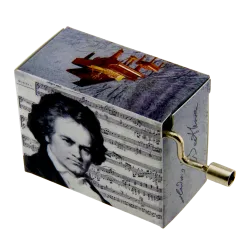
Music Box Arabesque — This German mechanical music box by Fridolin plays the delicate melody of Debussy's Arabesque, its metal tines plucked by a rotating cylinder to produce crystalline and nostalgic sounds. The printed cardboard case features Gustav Klimt's masterpiece "The Kiss", uniting visual art and mechanical music in a pocket-sized object (8.5 × 4.5 × 3 cm). Ideal as a thoughtful gift, collector's piece, or introduction to pre-digital musical mechanics. A musical treasure that connects generations of artisanal craftsmanship.
| Origin | Germany |
|---|---|
| Weight | 0,07 kg |
| Dimensions | 8,5 × 4,5 × 3,0 cm |
| Materials | Cardboard - Metal - Wood |
| Category | Classical music |
⚠Caution: Not suitable for children under 3 years. Please supervise older children. Beware of swallowing small parts, strangulation, material allergies, sharp edges and points! Use only for sound generation. No liability for improper use.
✦Care: Extreme temperature fluctuations, humidity and direct sunlight can affect the lifespan. Please store in balanced humidity to prevent material changes, mold and corrosion. Remove dirt with a damp cloth. Dry after cleaning and each use.
♻Disposal: Please contact your local waste disposal authority for information on environmentally sound disposal!
Music Box Arabesque
This small mechanical music box plays a delicate melody through the interaction of metal tines and a rotating cylinder — a direct descendant of 18th-century automata that brought music into homes before electric amplification existed. The Arabesque music box produces crystalline, nostalgic tones by plucking metal lamellae as the mechanism turns, a method that remains mechanically elegant and entirely acoustic.
Sound and Resonance
The music box generates sound at a modest volume by default. To increase audible intensity, remove the box from its printed cardboard sleeve and press it gently against a resonant surface — a table, shelf, or wooden box — while operating the mechanism. This transfers vibration to a larger surface area, allowing the tones to project more effectively into the room. The principle is acoustic rather than electronic: the vibrating metal tines couple their energy to the resonance body, which then radiates sound more efficiently.
Construction and Materials
The music box is built from cardboard, metal, and wood in a compact format. The printed cardboard exterior serves both protective and decorative functions, while the internal mechanism relies on metal components and wooden structural elements to house and drive the tine-striking apparatus. This combination of materials is typical of portable mechanical music boxes designed for domestic use and travel.
Visual Design
The exterior decoration reproduces Gustav Klimt's painting "The Kiss," a prominent work from early 20th-century Viennese art. The pairing of this visual motif with the mechanical music-making creates a synthesis of visual and auditory aesthetics in a single object.
What's Included
The music box arrives in its decorated cardboard packaging, which functions as both protective case and presentation container. The mechanism is ready to operate upon removal.
Mechanical Music and Historical Context
Music boxes represent a pre-digital approach to mechanical sound reproduction, developed across Europe from the late 1700s onward. They rely on a precisely manufactured cylinder with strategically placed pins that engage tuned metal tines as the mechanism rotates. This technology enabled music to be "stored" in physical form and reproduced identically with each operation — a concept that prefigures modern recording by more than a century. The Arabesque melody performed here belongs to the classical piano repertoire, adapted for mechanical performance.
Music boxes remain functional objects in households and collections, serving simultaneously as working instruments, decorative pieces, and tangible records of pre-electronic sound technology.

Your review appreciation cannot be sent
Report comment
Report sent
Your report cannot be sent
Write your review
Review sent
Your review cannot be sent