Music Box Beethoven Ode to Joy
Music Box — Beethoven's Ode to Joy
Turning the crank of this mechanical music box releases the opening theme of Beethoven's "Ode to Joy," one of the most recognizable melodies in Western classical music. The mechanism operates on a simple principle: the crank drives a pin-studded cylinder that plucks a tuned metal comb, producing the characteristic bright, precise tones of a traditional barrel organ.
How the Mechanism Works
The music box contains a small wooden board on which the mechanical movement is mounted. When you turn the crank at a steady pace, the cylinder rotates and its pins engage the metal teeth in sequence, playing the melody. The sound projects most effectively when the entire box is placed against a larger resonating surface—a table, chair, or wooden box—which amplifies the tone and allows the full character of the mechanism to emerge.
Materials and Construction
The box is built from cardboard, wood, and metal components. This combination of materials keeps the overall weight minimal while providing enough structural integrity to house the mechanical movement and allow it to function reliably when the crank is turned.
The Composition and Its History
Beethoven incorporated the "Ode to Joy" into his Ninth Symphony, completed in 1824, setting words written by Friedrich Schiller to music. Schiller composed the poem in 1785, envisioning a society united in joy and equality. Beethoven created this monumental work despite being almost entirely deaf at the time, making the symphony and its choral finale among the most celebrated compositions in the classical repertoire.
Playing and Storage
Turn the mechanism by turning the crank smoothly and at a consistent tempo. Store the music box in a dry location and avoid subjecting it to prolonged humidity or extreme temperature changes, which can affect the wooden components and the precision of the mechanism.
The music box remains a direct descendant of 18th-century mechanical instruments, preserving the mechanical approach to music-making that preceded electrical and electronic sound reproduction.

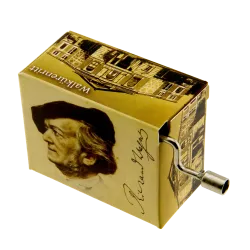
Music Box Beethoven Ode to Joy — A hand-crank music box that plays Beethoven's beloved "Ode to Joy" through a precision mechanical movement. German-made and compact at 6 cm tall, this charming collector's piece features an elegant glass dome and decorative portrait design. Turn the crank at a steady pace to hear the iconic melody—one of the most recognizable compositions in classical music—rendered with surprising clarity. A thoughtful gift for classical music enthusiasts and a gentle introduction to mechanical music for children. Portable history that transforms a moment into melody.
| Origin | Germany |
|---|---|
| Weight | 0,07 kg |
| Dimensions | 8,5 × 4,5 × 3,0 cm |
| Materials | Cardboard - Metal - Wood |
| Category | Classical music |
⚠Caution: Not suitable for children under 3 years. Please supervise older children. Beware of swallowing small parts, strangulation, material allergies, sharp edges and points! Use only for sound generation. No liability for improper use.
✦Care: Extreme temperature fluctuations, humidity and direct sunlight can affect the lifespan. Please store in balanced humidity to prevent material changes, mold and corrosion. Remove dirt with a damp cloth. Dry after cleaning and each use.
♻Disposal: Please contact your local waste disposal authority for information on environmentally sound disposal!
Music Box — Beethoven's Ode to Joy
Turning the crank of this mechanical music box releases the opening theme of Beethoven's "Ode to Joy," one of the most recognizable melodies in Western classical music. The mechanism operates on a simple principle: the crank drives a pin-studded cylinder that plucks a tuned metal comb, producing the characteristic bright, precise tones of a traditional barrel organ.
How the Mechanism Works
The music box contains a small wooden board on which the mechanical movement is mounted. When you turn the crank at a steady pace, the cylinder rotates and its pins engage the metal teeth in sequence, playing the melody. The sound projects most effectively when the entire box is placed against a larger resonating surface—a table, chair, or wooden box—which amplifies the tone and allows the full character of the mechanism to emerge.
Materials and Construction
The box is built from cardboard, wood, and metal components. This combination of materials keeps the overall weight minimal while providing enough structural integrity to house the mechanical movement and allow it to function reliably when the crank is turned.
The Composition and Its History
Beethoven incorporated the "Ode to Joy" into his Ninth Symphony, completed in 1824, setting words written by Friedrich Schiller to music. Schiller composed the poem in 1785, envisioning a society united in joy and equality. Beethoven created this monumental work despite being almost entirely deaf at the time, making the symphony and its choral finale among the most celebrated compositions in the classical repertoire.
Playing and Storage
Turn the mechanism by turning the crank smoothly and at a consistent tempo. Store the music box in a dry location and avoid subjecting it to prolonged humidity or extreme temperature changes, which can affect the wooden components and the precision of the mechanism.
The music box remains a direct descendant of 18th-century mechanical instruments, preserving the mechanical approach to music-making that preceded electrical and electronic sound reproduction.

Your review appreciation cannot be sent
Report comment
Report sent
Your report cannot be sent
Write your review
Review sent
Your review cannot be sent