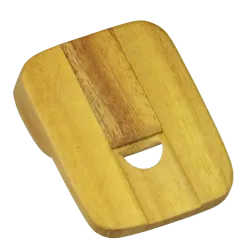
Wooden Nose Flute Kids Size
Nose Whistle for Children
A nose whistle is a wind instrument played entirely through the nostrils, with the mouth held open to function as a resonance chamber. This smaller version is sized and proportioned for children, making it an accessible entry point to an unusual and playful instrument family.
How It Works
You hold the whistle against your nostrils and exhale gently through your nose while keeping your mouth open. The shape and position of your mouth cavity directly affects the pitch and timbre of the sound produced. By adjusting the opening of your mouth and the angle of your jaw, you can vary the tone across a wide range — from high, bright notes to warmer, lower tones.
The instrument produces a soft, controlled sound that responds immediately to changes in mouth shape and air pressure. This direct relationship between embouchure and pitch makes it responsive to intentional variation rather than dependent on finger technique or complex mechanics.
Sound Possibilities
Despite its simplicity, the nose whistle is capable of producing a broad palette of sounds. Players can achieve effects ranging from bird-like warbling to recognizable melodic passages. The open-mouth resonance chamber allows for subtle tonal shifts and expressive control, making it suitable for both playful experimentation and structured musical phrases.
Material and Construction
The whistle is crafted from oiled jackfruit wood, a material that is lightweight and resonant. The finish is smooth and finished to a natural sheen, making it comfortable against the skin during play.
Getting Started
The instrument arrives ready to play — no assembly or preparation is required. Begin by holding it gently against your nostrils and experimenting with different mouth shapes while exhaling softly. The learning curve is gradual; initial sounds emerge quickly, while developing control and range takes gentle, regular practice.
Care and Maintenance
After use, wipe the interior and exterior with a soft, dry cloth to remove any moisture. Store in a dry environment. The oiled wood finish requires no special treatment beyond occasional light wiping to maintain its appearance.
Nose whistles remain a folk curiosity and playful instrument across Southeast Asian traditions, valued as much for their novelty and accessibility as for their genuine tonal range.
Wooden Nose Flute Kids Size — A traditional wind instrument from South-East Asia, this small wooden nose flute made from jackfruit wood is played by blowing through the nose, offering soft and warm sounds with tonal variations depending on the shape of the mouth. Designed for young musicians, it develops respiratory control, coordination and sound awareness whilst introducing children to musical traditions from around the world. Ready to use, easy to maintain. A unique musical introduction to ancestral sound horizons.
| Origin | Vietnam |
|---|---|
| Weight | 0,02 kg |
| Dimensions | 6,0 × 4,0 × 2,0 cm |
| Materials | Oiled jackwood - Wood |
⚠Caution: Not suitable for children under 3 years. Please supervise older children. Beware of swallowing small parts, strangulation, material allergies, sharp edges and points! Use only for sound generation. No liability for improper use.
✦Care: Extreme temperature fluctuations, humidity and direct sunlight can affect the lifespan. Please store in balanced humidity to prevent material changes, mold and corrosion. Remove dirt with a damp cloth. Dry after cleaning and each use.
♻Disposal: Please contact your local waste disposal authority for information on environmentally sound disposal!
Nose Whistle for Children
A nose whistle is a wind instrument played entirely through the nostrils, with the mouth held open to function as a resonance chamber. This smaller version is sized and proportioned for children, making it an accessible entry point to an unusual and playful instrument family.
How It Works
You hold the whistle against your nostrils and exhale gently through your nose while keeping your mouth open. The shape and position of your mouth cavity directly affects the pitch and timbre of the sound produced. By adjusting the opening of your mouth and the angle of your jaw, you can vary the tone across a wide range — from high, bright notes to warmer, lower tones.
The instrument produces a soft, controlled sound that responds immediately to changes in mouth shape and air pressure. This direct relationship between embouchure and pitch makes it responsive to intentional variation rather than dependent on finger technique or complex mechanics.
Sound Possibilities
Despite its simplicity, the nose whistle is capable of producing a broad palette of sounds. Players can achieve effects ranging from bird-like warbling to recognizable melodic passages. The open-mouth resonance chamber allows for subtle tonal shifts and expressive control, making it suitable for both playful experimentation and structured musical phrases.
Material and Construction
The whistle is crafted from oiled jackfruit wood, a material that is lightweight and resonant. The finish is smooth and finished to a natural sheen, making it comfortable against the skin during play.
Getting Started
The instrument arrives ready to play — no assembly or preparation is required. Begin by holding it gently against your nostrils and experimenting with different mouth shapes while exhaling softly. The learning curve is gradual; initial sounds emerge quickly, while developing control and range takes gentle, regular practice.
Care and Maintenance
After use, wipe the interior and exterior with a soft, dry cloth to remove any moisture. Store in a dry environment. The oiled wood finish requires no special treatment beyond occasional light wiping to maintain its appearance.
Nose whistles remain a folk curiosity and playful instrument across Southeast Asian traditions, valued as much for their novelty and accessibility as for their genuine tonal range.
Your review appreciation cannot be sent
Report comment
Report sent
Your report cannot be sent
Write your review
Review sent
Your review cannot be sent