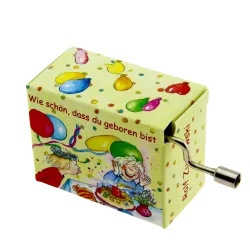
Music Box Bizet Carmen Habanera
Music Box — Bizet: Carmen, Habanera
This small mechanical music box plays one of opera's most recognisable melodies: the Habanera from Georges Bizet's opera Carmen. The mechanism requires no batteries or electricity — it runs entirely on a hand crank driving a precisely tuned metal comb that vibrates against a rotating cylinder, producing the delicate, metallic character typical of the traditional music box sound.
The Habanera and its place in opera
The Habanera is the moment in Carmen where the lead character sings of love's contradictory and uncontrollable nature. Bizet composed the opera in 1875, but died just three months after its première, never witnessing the work's eventual international success. Today, Carmen ranks among the most frequently performed operas in the world, and its principal melodies — including the Habanera and the Toreador March — are recognised on every continent.
Construction and sound amplification
The music box is constructed from cardboard, metal and wood. The wooden base acts as a resonating body: placing the box on a larger surface such as a table, chair or shelf amplifies the sound, making the melody louder and fuller than it would be in isolation. This simple principle of acoustic amplification has been central to music box design for centuries.
Contents and use
The music box arrives ready to play. Turn the crank to hear the Habanera unfold. It works equally well as a daily musical moment on a desk or bedside table, as an introduction to classical opera for young listeners, or as a gift for collectors and opera enthusiasts.
The Habanera remains one of the most widely recognised melodies in opera, and this mechanical rendition preserves a tradition of portable, non-electric music that has endured since the 18th century.

Music Box - Bizet: Carmen, Habanera — This mechanical music box brings Bizet's most recognisable opera melody to life in compact form, playing the iconic Habanera from Carmen with a delicate, warm sound. The durable cylinder mechanism is mounted on resonant wood, amplifying the sound of the precisely tuned metal comb inside — a traditional European craft requiring no batteries or electricity. Measuring just 8.5 × 4.5 × 3.0 cm and made in Germany, it works equally well as a daily musical moment on a desk or bedside table, as a teaching tool for introducing young listeners to classical opera, or as a thoughtful gift for collectors and opera lovers. A window onto one of music's most beloved melodies.
| Origin | Germany |
|---|---|
| Weight | 0,07 kg |
| Dimensions | 8,5 × 4,5 × 3,0 cm |
| Materials | Cardboard - Metal - Wood |
| Category | Classical music |
⚠Caution: Not suitable for children under 3 years. Please supervise older children. Beware of swallowing small parts, strangulation, material allergies, sharp edges and points! Use only for sound generation. No liability for improper use.
✦Care: Extreme temperature fluctuations, humidity and direct sunlight can affect the lifespan. Please store in balanced humidity to prevent material changes, mold and corrosion. Remove dirt with a damp cloth. Dry after cleaning and each use.
♻Disposal: Please contact your local waste disposal authority for information on environmentally sound disposal!
Music Box — Bizet: Carmen, Habanera
This small mechanical music box plays one of opera's most recognisable melodies: the Habanera from Georges Bizet's opera Carmen. The mechanism requires no batteries or electricity — it runs entirely on a hand crank driving a precisely tuned metal comb that vibrates against a rotating cylinder, producing the delicate, metallic character typical of the traditional music box sound.
The Habanera and its place in opera
The Habanera is the moment in Carmen where the lead character sings of love's contradictory and uncontrollable nature. Bizet composed the opera in 1875, but died just three months after its première, never witnessing the work's eventual international success. Today, Carmen ranks among the most frequently performed operas in the world, and its principal melodies — including the Habanera and the Toreador March — are recognised on every continent.
Construction and sound amplification
The music box is constructed from cardboard, metal and wood. The wooden base acts as a resonating body: placing the box on a larger surface such as a table, chair or shelf amplifies the sound, making the melody louder and fuller than it would be in isolation. This simple principle of acoustic amplification has been central to music box design for centuries.
Contents and use
The music box arrives ready to play. Turn the crank to hear the Habanera unfold. It works equally well as a daily musical moment on a desk or bedside table, as an introduction to classical opera for young listeners, or as a gift for collectors and opera enthusiasts.
The Habanera remains one of the most widely recognised melodies in opera, and this mechanical rendition preserves a tradition of portable, non-electric music that has endured since the 18th century.

Your review appreciation cannot be sent
Report comment
Report sent
Your report cannot be sent
Write your review
Review sent
Your review cannot be sent