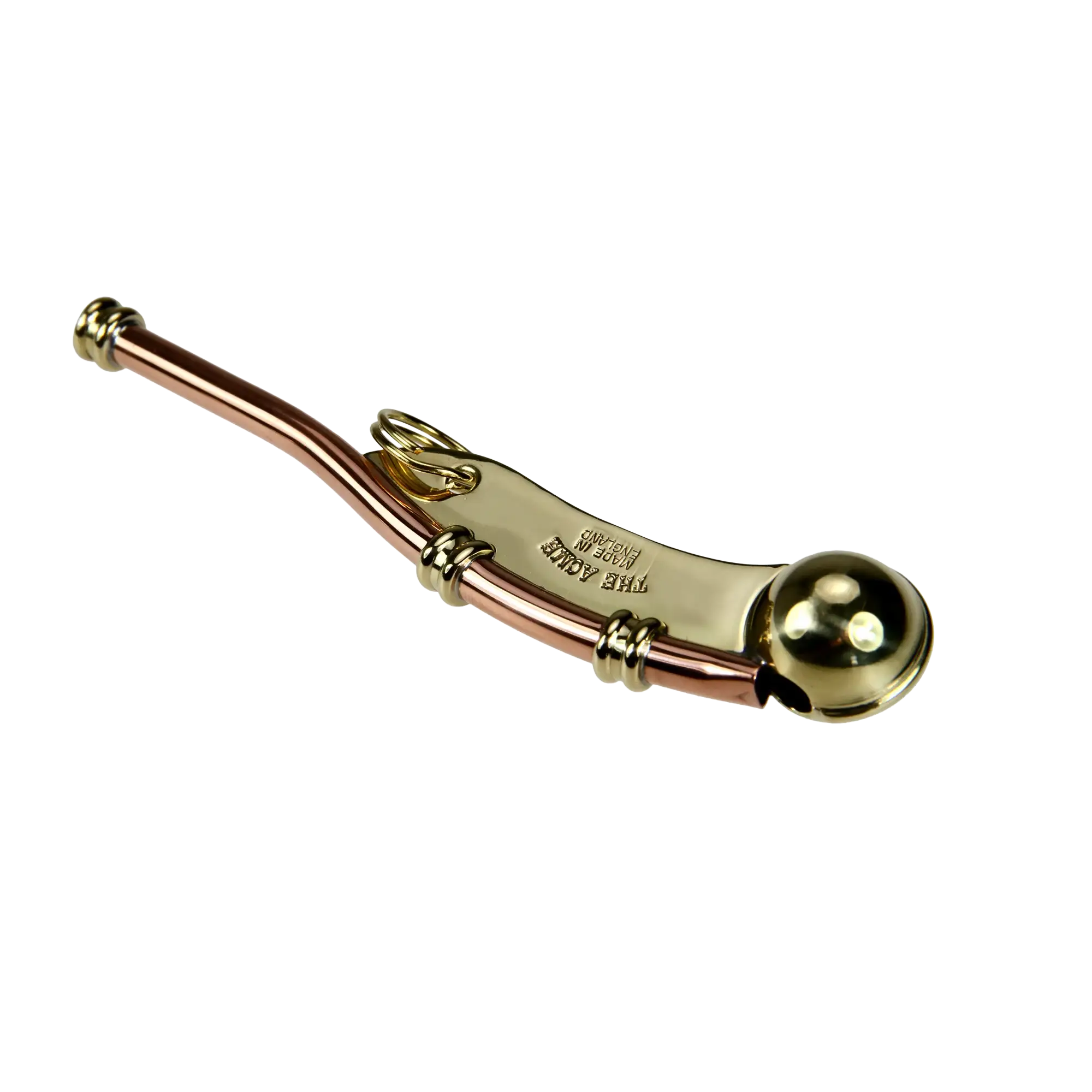
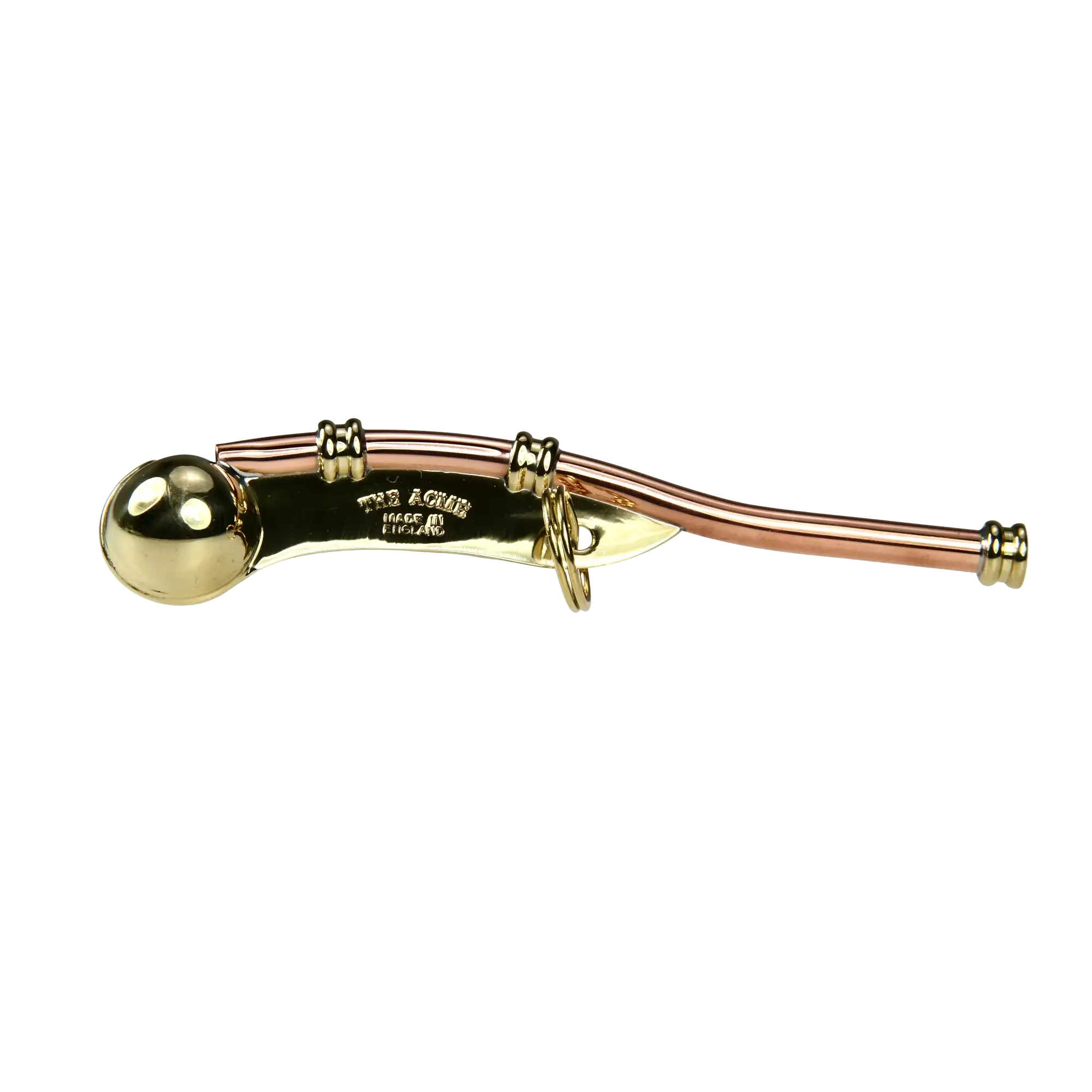
ACME Boatswains Pipe

Price: €33.21
SKU ACB-1 Category Acme

The Boatswain's Whistle: A Naval Signalling Tool

This brass whistle is a direct descendant of the signalling instruments that have coordinated maritime crews since the medieval period. Its primary function—transmitting commands across the deck and through adverse weather—shaped a design of remarkable simplicity and proven effectiveness. The high-pitched tone cuts through wind and distance without strain, making it capable of reaching crew members where the human voice cannot.

Historical Role at Sea

From the 13th century onward, boatswains relied on this whistle to issue orders aboard sailing vessels. In conditions of fog, storm, or when crew members were scattered across rigging and deck, the whistle's penetrating sound conveyed standardised commands that the entire crew understood instantly. This was not ornamental—it was essential infrastructure for coordinating complex maritime operations.

The design proved so effective that it has remained essentially unchanged for centuries. No fundamental improvement was ever needed; the aerodynamic principles that produce the tone, the material choices that ensure durability, and the size that allows it to be carried and deployed instantly all work together without redundancy.

Construction and Materials

Brass provides both acoustic and practical advantages. It resists corrosion in salt-air environments, a critical requirement for any tool meant to survive years aboard ship. The material also contributes to the whistle's tonal character—the density and rigidity of brass produce a clear, focused pitch that does not diffuse or weaken over distance.

The whistle's internal structure is straightforward: a windway channels breath into a small chamber where it is interrupted by a sharp edge, creating the vibration that generates sound. This simplicity is not a limitation—it is the foundation of the instrument's reliability and its capacity for expressive variation.

Playing Technique and Tonal Range

Despite its small size and simple construction, the whistle responds to subtle changes in breath control and hand position. You can vary the pitch and timbre by covering and uncovering the whistle opening with your hand, allowing for a range of tones from a single instrument. Tongue articulation—moving the tongue to interrupt the airflow—produces trills and rhythmic patterns that add complexity to what might otherwise be a single note.

This capacity for modulation means the whistle can convey more than a simple on-off signal. A skilled player can produce inflection, urgency, or distinction between different command types, all within the constraints of the instrument's fundamental pitch.

Contemporary Applications

The whistle's role has expanded beyond active seafaring. It appears in naval ceremonies and formal maritime occasions, where it carries historical weight and establishes continuity with centuries of tradition. Educational programmes in sailing and maritime history use it to teach students how crews communicated before radio. Historical reenactments and theatrical productions value it for its authenticity and its ability to produce a distinctive, immediately recognisable sound.

Care and Use

The brass construction requires minimal maintenance. Occasional cleaning with a soft cloth removes salt spray and oxidation. The whistle produces sound without moving parts or internal mechanisms that can wear or fail, making it exceptionally durable. A single whistle can serve reliably for decades with no repair or adjustment.

The boatswain's whistle remains in use wherever maritime tradition is maintained or recreated—a tool so well-suited to its purpose that its design has outlasted the wooden sailing ships it once commanded.
Price: €33.21
SKU ACB-1 Category Acme

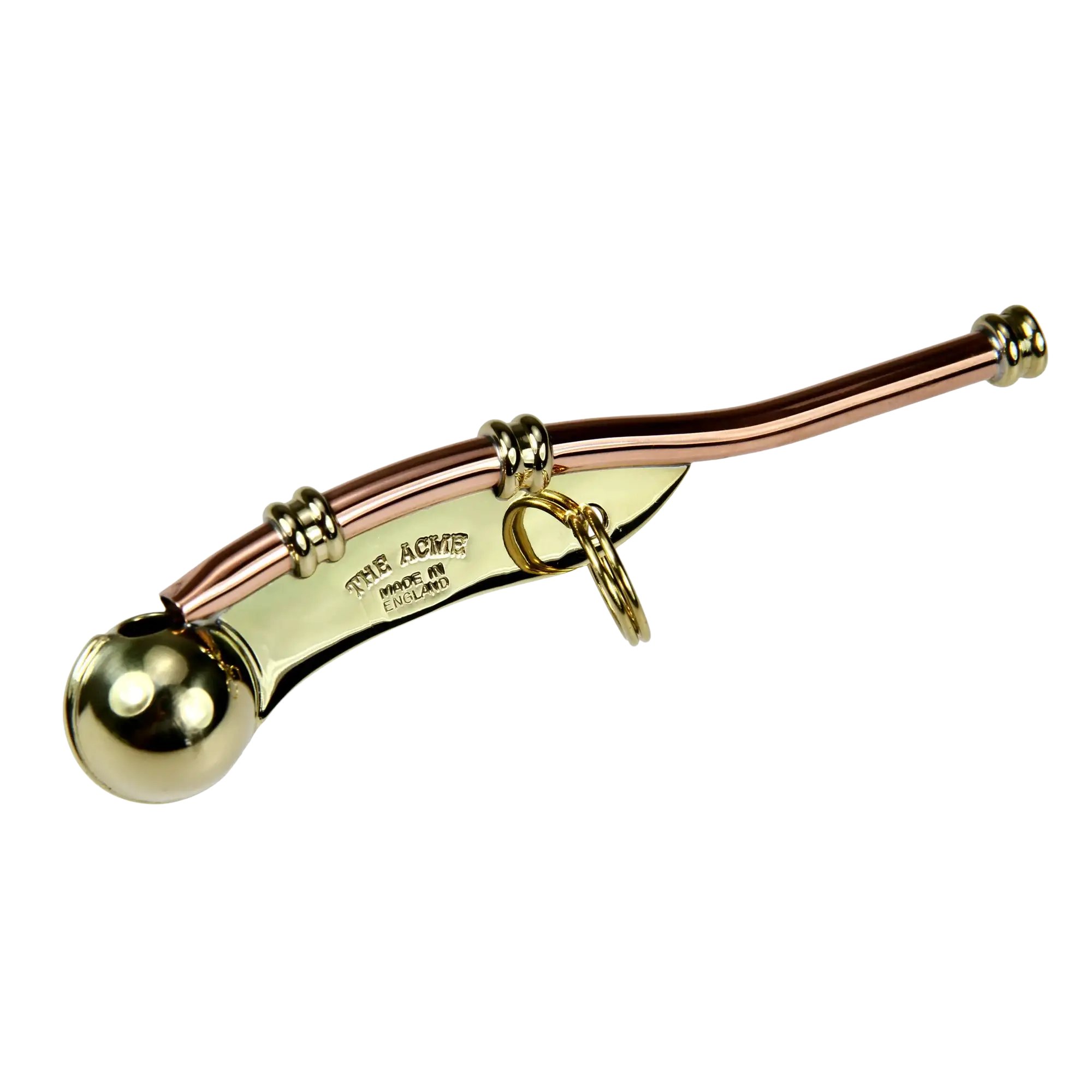
ACME Boatswains Pipe — Authentic British naval whistle in nickel-plated brass, faithfully reproducing the historical design that commanded sailing crews for centuries. Its piercing, far-carrying tone cuts through wind and noise with minimal effort, making it essential for maritime ceremonies, historical reenactments, sailing instruction, and theatrical productions. A functional connection to centuries of maritime tradition.

Origin Great Britain
Weight 0,04 kg
Dimensions 11,5 × 2,0 cm
Materials Brass
Audio Samples
ACME Boatswains Pipe

Caution: Not suitable for children under 3 years. Please supervise older children. Beware of swallowing small parts, strangulation, material allergies, sharp edges and points! Use only for sound generation. No liability for improper use.

Care: Extreme temperature fluctuations, humidity and direct sunlight can affect the lifespan. Please store in balanced humidity to prevent material changes, mold and corrosion. Remove dirt with a damp cloth. Dry after cleaning and each use.

Disposal: Please contact your local waste disposal authority for information on environmentally sound disposal!

Cet instrument vous a touché ? Faites-le découvrir.

La musique du monde se transmet — partagez cette découverte.

The Boatswain's Whistle: A Naval Signalling Tool

This brass whistle is a direct descendant of the signalling instruments that have coordinated maritime crews since the medieval period. Its primary function—transmitting commands across the deck and through adverse weather—shaped a design of remarkable simplicity and proven effectiveness. The high-pitched tone cuts through wind and distance without strain, making it capable of reaching crew members where the human voice cannot.

Historical Role at Sea

From the 13th century onward, boatswains relied on this whistle to issue orders aboard sailing vessels. In conditions of fog, storm, or when crew members were scattered across rigging and deck, the whistle's penetrating sound conveyed standardised commands that the entire crew understood instantly. This was not ornamental—it was essential infrastructure for coordinating complex maritime operations.

The design proved so effective that it has remained essentially unchanged for centuries. No fundamental improvement was ever needed; the aerodynamic principles that produce the tone, the material choices that ensure durability, and the size that allows it to be carried and deployed instantly all work together without redundancy.

Construction and Materials

Brass provides both acoustic and practical advantages. It resists corrosion in salt-air environments, a critical requirement for any tool meant to survive years aboard ship. The material also contributes to the whistle's tonal character—the density and rigidity of brass produce a clear, focused pitch that does not diffuse or weaken over distance.

The whistle's internal structure is straightforward: a windway channels breath into a small chamber where it is interrupted by a sharp edge, creating the vibration that generates sound. This simplicity is not a limitation—it is the foundation of the instrument's reliability and its capacity for expressive variation.

Playing Technique and Tonal Range

Despite its small size and simple construction, the whistle responds to subtle changes in breath control and hand position. You can vary the pitch and timbre by covering and uncovering the whistle opening with your hand, allowing for a range of tones from a single instrument. Tongue articulation—moving the tongue to interrupt the airflow—produces trills and rhythmic patterns that add complexity to what might otherwise be a single note.

This capacity for modulation means the whistle can convey more than a simple on-off signal. A skilled player can produce inflection, urgency, or distinction between different command types, all within the constraints of the instrument's fundamental pitch.

Contemporary Applications

The whistle's role has expanded beyond active seafaring. It appears in naval ceremonies and formal maritime occasions, where it carries historical weight and establishes continuity with centuries of tradition. Educational programmes in sailing and maritime history use it to teach students how crews communicated before radio. Historical reenactments and theatrical productions value it for its authenticity and its ability to produce a distinctive, immediately recognisable sound.

Care and Use

The brass construction requires minimal maintenance. Occasional cleaning with a soft cloth removes salt spray and oxidation. The whistle produces sound without moving parts or internal mechanisms that can wear or fail, making it exceptionally durable. A single whistle can serve reliably for decades with no repair or adjustment.

The boatswain's whistle remains in use wherever maritime tradition is maintained or recreated—a tool so well-suited to its purpose that its design has outlasted the wooden sailing ships it once commanded.

Recently viewed

Comments (0)
No customer reviews for the moment.

You might also like