Jaw Harp Morchang Mohan Superb V Brass
Morchang Mohan Superb V — Brass Jaw Harp from Rajasthan
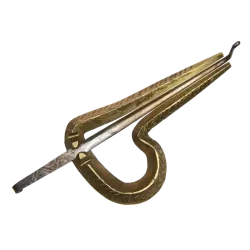
This brass jaw harp represents a direct lineage of metalworking tradition in Rajasthan, handforged by the master smith Mohan Lal in 2010. The instrument belongs to the family of toothed jaw harps—idiophones that produce sound through the vibration of a flexible metal tongue held against the player's teeth, shaped and modulated by the mouth cavity and breath.
Construction and Material
The frame is cast and finished in brass, a choice that affects both durability and tonal character. Brass instruments of this type produce warm, resonant tones with good projection, qualities that emerge from the metal's acoustic properties and the smith's control during forging.
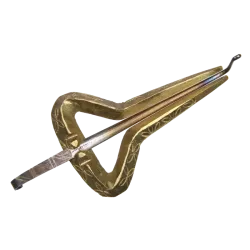
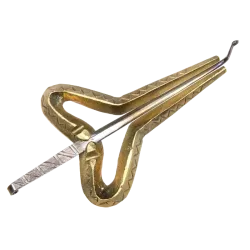
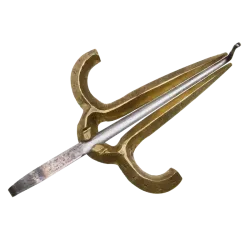
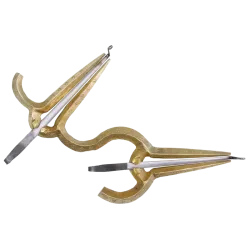
The frame geometry is described as rare in its shape, suggesting a design refined through years of craft practice rather than standardized production. This particularity may influence how the instrument sits in the mouth and how air flows across the vibrating tongue, though the precise sonic consequences depend on individual playing technique.
Playing and Sound
Jaw harps operate on a principle of free tuning—the pitch and timbre are not fixed by the instrument alone but emerge from the interaction between the vibrating metal tongue and the player's mouth position, breath pressure, and vocal tract shape. You hold the frame lightly against your teeth, pluck or strike the tongue to set it in motion, and then vary pitch and tone by adjusting your mouth cavity, tongue position, and breath control.
This responsiveness makes the jaw harp an intimate instrument; subtle changes in embouchure produce distinct harmonic shifts and tonal colors. The brass construction supports clear articulation and sustain, qualities valued in both solo and ensemble contexts.
What's Included
- Protective transport blocks
- Quick-start guide
The transport blocks protect the frame during storage and travel, while the guide provides entry-level instruction for new players unfamiliar with the technique.
The jaw harp remains a foundational voice in folk music traditions across the Indian subcontinent, played in both ceremonial and social contexts, and increasingly adopted by contemporary musicians exploring non-Western instrumental vocabularies.
Jaw Harp Morchang Mohan Superb V Brass — A hand-forged jaw harp from Rajasthan, this brass morchang carries centuries of folk tradition in a 10 cm frame. Crafted by master smith Mohan Lal, it produces warm, resonant tones shaped by breath and mouth position—ideal for traditional Rajasthani ensembles, world music collaboration, or meditative soundscapes. Includes protective transport blocks and quick-start guide. An authentic voice from the desert, responsive and intimate in hand.
| Origin | India |
|---|---|
| Weight | 0,05 kg |
| Dimensions | 10,0 cm |
| Included | Transport blocks, quick guide |
| Materials | Brass |
| Key | Free Tuning |
| Jaw Harp Type | Teeth-activated jaw harp |
⚠Caution: Not suitable for children under 3 years. Please supervise older children. Beware of swallowing small parts, strangulation, material allergies, sharp edges and points! Use only for sound generation. No liability for improper use.
✦Care: Extreme temperature fluctuations, humidity and direct sunlight can affect the lifespan. Please store in balanced humidity to prevent material changes, mold and corrosion. Remove dirt with a damp cloth. Dry after cleaning and each use.
♻Disposal: Please contact your local waste disposal authority for information on environmentally sound disposal!
Morchang Mohan Superb V — Brass Jaw Harp from Rajasthan
This brass jaw harp represents a direct lineage of metalworking tradition in Rajasthan, handforged by the master smith Mohan Lal in 2010. The instrument belongs to the family of toothed jaw harps—idiophones that produce sound through the vibration of a flexible metal tongue held against the player's teeth, shaped and modulated by the mouth cavity and breath.
Construction and Material
The frame is cast and finished in brass, a choice that affects both durability and tonal character. Brass instruments of this type produce warm, resonant tones with good projection, qualities that emerge from the metal's acoustic properties and the smith's control during forging.
The frame geometry is described as rare in its shape, suggesting a design refined through years of craft practice rather than standardized production. This particularity may influence how the instrument sits in the mouth and how air flows across the vibrating tongue, though the precise sonic consequences depend on individual playing technique.
Playing and Sound
Jaw harps operate on a principle of free tuning—the pitch and timbre are not fixed by the instrument alone but emerge from the interaction between the vibrating metal tongue and the player's mouth position, breath pressure, and vocal tract shape. You hold the frame lightly against your teeth, pluck or strike the tongue to set it in motion, and then vary pitch and tone by adjusting your mouth cavity, tongue position, and breath control.
This responsiveness makes the jaw harp an intimate instrument; subtle changes in embouchure produce distinct harmonic shifts and tonal colors. The brass construction supports clear articulation and sustain, qualities valued in both solo and ensemble contexts.
What's Included
- Protective transport blocks
- Quick-start guide
The transport blocks protect the frame during storage and travel, while the guide provides entry-level instruction for new players unfamiliar with the technique.
The jaw harp remains a foundational voice in folk music traditions across the Indian subcontinent, played in both ceremonial and social contexts, and increasingly adopted by contemporary musicians exploring non-Western instrumental vocabularies.
Your review appreciation cannot be sent
Report comment
Report sent
Your report cannot be sent
Write your review
Review sent
Your review cannot be sent