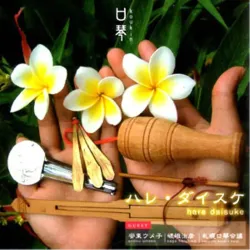
Daisuke Hare - Hoshizora Kohkin
Hoshizora Kohkin — Daisuke Hare
This 2001 recording captures a distinctive approach to the jaw harp, an instrument with roots across Europe, Asia, and beyond. Daisuke Hare, a dedicated collector and performer of jaw harps, leads an ensemble that treats the instrument not as a folk relic but as a voice capable of dialogue with contemporary world music idioms.
The Ensemble and Instrumentation
Hare performs multiple jaw harps throughout the album, joined by a singing saw — an unusual pairing that extends the tonal palette beyond what either instrument typically achieves alone. The core ensemble includes the group Hard To Find alongside Hiroko Ara, whose contributions span flutes, dulcimer, concertina, fiddle, and guitar. This combination of instruments draws from European folk traditions, Japanese sensibilities, and world fusion approaches, creating a setting where the jaw harp functions as both a lead voice and a textural element.
Repertoire and Musical Direction
The thirteen tracks span traditional material and original compositions. Traditional pieces include Irish jigs and marches, Finnish polkas, and folk melodies from multiple cultures, while original works such as "The Etude For Jaw Harp" and compositions by Kenji Komatsuzaki and Misao Komatsuzaki demonstrate how the jaw harp can be integrated into contemporary arrangements. This mixture reflects a deliberate curation — the album explores how a single acoustic instrument can navigate between preservation and reimagining.
Sound and Performance Context
The jaw harp's characteristic bright, percussive timbre and its capacity for pitch and tonal variation become apparent across these arrangements. Paired with the singing saw's sustained, wavering quality, the jaw harp gains space to articulate melody and rhythm without competing for sonic territory. The ensemble's approach emphasizes clarity and interaction rather than density, allowing each instrument's voice to remain distinct.
The jaw harp remains a minority voice in world music recording, and this album documents one musician's sustained commitment to exploring its expressive range within a collaborative, contemporary context.
Daisuke Hare - Hoshizora Kohkin — a 2001 world fusion album featuring Japanese mouth organ artist Daisuke Hare performing various kokyu and singing nocturnes alongside collaborators including the band Hard to Find and musician Hiroko Ara on flute, hammered dulcimer, concertina, violin, and guitar. 13 tracks, 44 minutes 1 second total. An intimate exploration of traditional and contemporary Japanese wind music across world fusion contexts.
| Origin | Japan |
|---|---|
| Weight | 0,10 kg |
| Tracks | 13 |
| Publication Year | 2001 |
| Genre | World Fusion |
| Duration | 44'01" |
Hoshizora Kohkin — Daisuke Hare
This 2001 recording captures a distinctive approach to the jaw harp, an instrument with roots across Europe, Asia, and beyond. Daisuke Hare, a dedicated collector and performer of jaw harps, leads an ensemble that treats the instrument not as a folk relic but as a voice capable of dialogue with contemporary world music idioms.
The Ensemble and Instrumentation
Hare performs multiple jaw harps throughout the album, joined by a singing saw — an unusual pairing that extends the tonal palette beyond what either instrument typically achieves alone. The core ensemble includes the group Hard To Find alongside Hiroko Ara, whose contributions span flutes, dulcimer, concertina, fiddle, and guitar. This combination of instruments draws from European folk traditions, Japanese sensibilities, and world fusion approaches, creating a setting where the jaw harp functions as both a lead voice and a textural element.
Repertoire and Musical Direction
The thirteen tracks span traditional material and original compositions. Traditional pieces include Irish jigs and marches, Finnish polkas, and folk melodies from multiple cultures, while original works such as "The Etude For Jaw Harp" and compositions by Kenji Komatsuzaki and Misao Komatsuzaki demonstrate how the jaw harp can be integrated into contemporary arrangements. This mixture reflects a deliberate curation — the album explores how a single acoustic instrument can navigate between preservation and reimagining.
Sound and Performance Context
The jaw harp's characteristic bright, percussive timbre and its capacity for pitch and tonal variation become apparent across these arrangements. Paired with the singing saw's sustained, wavering quality, the jaw harp gains space to articulate melody and rhythm without competing for sonic territory. The ensemble's approach emphasizes clarity and interaction rather than density, allowing each instrument's voice to remain distinct.
The jaw harp remains a minority voice in world music recording, and this album documents one musician's sustained commitment to exploring its expressive range within a collaborative, contemporary context.

Your review appreciation cannot be sent
Report comment
Report sent
Your report cannot be sent
Write your review
Review sent
Your review cannot be sent