Kou Xian (Ho Ho) Set of 4

Price: €25.43
SKU MSM-4 Category Kou Xian

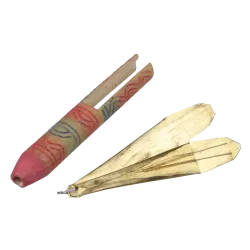
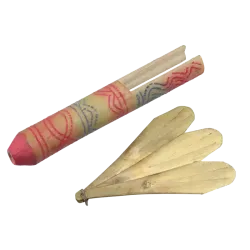
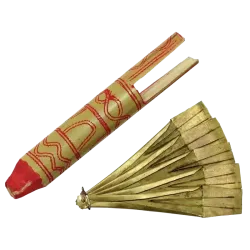
Set of 4 Kou Xian Jaw Harps

This set comprises four brass jaw harps, each tuned to its own fundamental pitch, allowing you to explore a range of tonal centers without switching instruments. The Kou Xian belongs to the family of lip-vibrated idiophones — instruments struck not against the teeth, as with many jaw harps, but against the lips, a technique that permits smoother transitions between notes and a different harmonic palette than tooth-struck variants.

Sound and Playing Range

Each lamella (the vibrating tongue of the instrument) produces a keynote, from which you can access multiple overtones by adjusting breath pressure and mouth cavity shape. The set's four instruments together create a broad harmonic landscape: you might sustain a low fundamental on one jaw harp while articulating faster passages on another, or layer overtones across all four for dense, shimmering textures. The "free tuning" specification means the instruments are not calibrated to concert pitch or any standardized interval system, but rather each jaw harp settles into its own natural resonance.

Construction and Materials

All four instruments are made from brass, a material that produces a bright, sustained tone and resists corrosion with minimal maintenance. The traditional handmade construction means slight variations between individual jaw harps are expected and contribute to the set's tonal variety rather than detracting from it.

Playing Technique

You hold a jaw harp between your lips (not clenched between the teeth) and pluck the lamella with your finger or fingernail to set it vibrating. Breath control shapes the overtone series: gentle, sustained breathing emphasizes lower harmonics, while sharper breath pulses and changes in mouth shape bring higher partials into prominence. The lip-strike method allows for legato transitions between pitches and a more vocal, vocal-like quality than the tooth-struck approach.

Cultural Context

The Kou Xian is a traditional instrument of the Yi people from Yunnan Province in southwestern China. Within that tradition, complex melodic patterns and ensemble playing are documented practices. For contemporary musicians, the set functions equally as a tool for exploring non-Western tuning systems, layering overtones in experimental composition, or simply discovering the expressive range hidden within a single, ancient design.

What's Included

  • Four brass Kou Xian jaw harps, each with its own tuning
  • Protective case
  • Playing instructions

Getting Started

The included instructions guide you through basic holding position, breath technique, and how to access overtones on each instrument. Because the jaw harps are not tuned to a fixed standard pitch, there is no "wrong" pitch to aim for — your ear will quickly adapt to each instrument's natural center and harmonic series. Many players spend initial sessions simply exploring how much tonal variety emerges from a single jaw harp before moving on to combining multiple instruments.

The jaw harp remains one of the oldest and most widely distributed instrument types across human cultures, played in traditions from Central Asia to the Pacific, and continues to attract musicians seeking direct control over overtone manipulation and acoustic intimacy.

Price: €25.43
SKU MSM-4 Category Kou Xian

Kou Xian (Ho Ho) Set of 4 — Four brass jaw harps from Yunnan, China, each tuned to its own pitch and played against the lips rather than the teeth, allowing smooth transitions between instruments. The set produces a rich palette of harmonics and overtones shaped by breath and mouth position, suitable for solo exploration, world music ensembles, or experimental composition. Includes protective case and playing instructions for beginners. A portable gateway to one of the world's oldest instrumental traditions.

This jaw harp is no longer available and cannot be supplied. As most jaw harps are individually handcrafted, instruments sometimes disappear from the market when their maker stops production. Rather than let this knowledge vanish, we have preserved this instrument in our Jaw Harp Archive, where it can continue to inform and inspire.
Origin China
Weight 0,03 kg
Dimensions 5,5 cm
Included Playing instructions, Jaw harp bag
Materials Brass
Key Free Tuning
Jaw Harp Type Lip-activated jaw harp
Audio Samples
Kou Xian (Ho Ho)

Caution: Not suitable for children under 3 years. Please supervise older children. Beware of swallowing small parts, strangulation, material allergies, sharp edges and points! Use only for sound generation. No liability for improper use.

Care: Extreme temperature fluctuations, humidity and direct sunlight can affect the lifespan. Please store in balanced humidity to prevent material changes, mold and corrosion. Remove dirt with a damp cloth. Dry after cleaning and each use.

Disposal: Please contact your local waste disposal authority for information on environmentally sound disposal!

Cet instrument vous a touché ? Faites-le découvrir.

La musique du monde se transmet — partagez cette découverte.

Set of 4 Kou Xian Jaw Harps

This set comprises four brass jaw harps, each tuned to its own fundamental pitch, allowing you to explore a range of tonal centers without switching instruments. The Kou Xian belongs to the family of lip-vibrated idiophones — instruments struck not against the teeth, as with many jaw harps, but against the lips, a technique that permits smoother transitions between notes and a different harmonic palette than tooth-struck variants.

Sound and Playing Range

Each lamella (the vibrating tongue of the instrument) produces a keynote, from which you can access multiple overtones by adjusting breath pressure and mouth cavity shape. The set's four instruments together create a broad harmonic landscape: you might sustain a low fundamental on one jaw harp while articulating faster passages on another, or layer overtones across all four for dense, shimmering textures. The "free tuning" specification means the instruments are not calibrated to concert pitch or any standardized interval system, but rather each jaw harp settles into its own natural resonance.

Construction and Materials

All four instruments are made from brass, a material that produces a bright, sustained tone and resists corrosion with minimal maintenance. The traditional handmade construction means slight variations between individual jaw harps are expected and contribute to the set's tonal variety rather than detracting from it.

Playing Technique

You hold a jaw harp between your lips (not clenched between the teeth) and pluck the lamella with your finger or fingernail to set it vibrating. Breath control shapes the overtone series: gentle, sustained breathing emphasizes lower harmonics, while sharper breath pulses and changes in mouth shape bring higher partials into prominence. The lip-strike method allows for legato transitions between pitches and a more vocal, vocal-like quality than the tooth-struck approach.

Cultural Context

The Kou Xian is a traditional instrument of the Yi people from Yunnan Province in southwestern China. Within that tradition, complex melodic patterns and ensemble playing are documented practices. For contemporary musicians, the set functions equally as a tool for exploring non-Western tuning systems, layering overtones in experimental composition, or simply discovering the expressive range hidden within a single, ancient design.

What's Included

  • Four brass Kou Xian jaw harps, each with its own tuning
  • Protective case
  • Playing instructions

Getting Started

The included instructions guide you through basic holding position, breath technique, and how to access overtones on each instrument. Because the jaw harps are not tuned to a fixed standard pitch, there is no "wrong" pitch to aim for — your ear will quickly adapt to each instrument's natural center and harmonic series. Many players spend initial sessions simply exploring how much tonal variety emerges from a single jaw harp before moving on to combining multiple instruments.

The jaw harp remains one of the oldest and most widely distributed instrument types across human cultures, played in traditions from Central Asia to the Pacific, and continues to attract musicians seeking direct control over overtone manipulation and acoustic intimacy.

Recently viewed

Comments (0)
No customer reviews for the moment.

You might also like