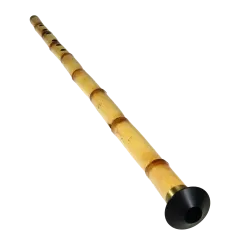
Persian Ney Pro

Price: €103.25
SKU PN-1F Category Ney

Persian Ney Pro

The Persian ney is among the world's oldest continuously played instruments, and this professional model represents the tradition in its most refined form. Crafted from giant cane, it produces a sound that ranges from smoky and warm in the lower register to finely pervasive tones in the upper octaves. The instrument's voice carries particular resonance in the Sufi musical tradition, where its expressive qualities have long served contemplative and spiritual practice.

Construction and Sound

This ney is built from arundo donax, the giant cane species that gives the instrument its characteristic tonal depth. Six finger holes, including one for the thumb on the back, allow for the full range of traditional Persian modes. The tuning of this model centers on F4, with a secondary pitch at F#4, establishing the instrument's tonal foundation.

The sound emerges through an open mouthpiece that remains fully inside the mouth during play, held with the blowing edge positioned between the teeth. This technique, which requires dedicated practice to master, is inseparable from the instrument's sonic identity. By adjusting lip position and mouth cavity shape, a player can alter the timbre, intonation and pitch of individual notes, creating the subtle inflections and ornamentations that define Persian classical music.

Playing Technique

The ney demands a different embouchure approach than most wind instruments in the Western tradition. You hold the instrument so that the open end sits entirely within your mouth, with the blowing edge gripped gently between your teeth. Air is directed across the opening rather than into a defined channel, requiring both breath control and precise lip positioning to produce a clear tone.

Once the basic sound is established, pitch and timbre become fluid. Subtle movements of the lips and adjustments to the oral cavity allow you to bend notes, shift between pitches and color individual tones. This capacity for microtonal expression makes the ney particularly suited to the ornamental melodic language of Persian classical music and the meditative soundscapes of Sufi practice.

Musical Context

In Persian classical music, the ney functions as both a solo voice and an ensemble instrument, capable of expressing the emotional and spiritual dimensions central to the tradition. Its presence in Sufi musical gatherings reflects a centuries-long association with practices aimed at deepening connection to the divine. The instrument's ability to sustain notes and shape them with expressive control makes it ideal for performing the complex modal structures and improvisational passages that characterize both contexts.

What's Included

  • The ney itself, professionally handcrafted

Care and Getting Started

Like all cane instruments, the ney benefits from careful handling and storage in a stable environment. The material will respond to changes in humidity and temperature, so protecting it from extremes will help preserve its playability and tonal qualities over time.

Learning the ney is best undertaken with guidance from an experienced player or teacher familiar with the instrument's particular embouchure and technique. The initial adjustment period—developing the mouth position, breath control and coordination needed to produce a clear, stable tone—typically requires patient, consistent practice.

The ney remains a primary voice in Persian classical music and Sufi musical traditions across the Middle East and beyond, valued for its capacity to express the subtlest emotional and spiritual dimensions of these practices.

Price: €103.25
SKU PN-1F Category Ney

Persian Ney Pro — A continuous reed flute of 60 cm in giant reed, tuned in F4, designed for serious musicians of classical and Sufi Persian music. Its six precisely positioned holes allow you to play all the traditional modes of the radif, whilst its voice transforms from a contemplative warmth in the lower register to a piercing clarity in the upper register. For those seeking an authentic voice capable of expressing the emotional and spiritual depth of the Persian tradition.

Tonality F4
Origin Turkey
Dimensions 60,0 cm
Materials Brass - Pile tube
Key F4 F#4

Caution: Not suitable for children under 3 years. Please supervise older children. Beware of swallowing small parts, strangulation, material allergies, sharp edges and points! Use only for sound generation. No liability for improper use.

Care: Extreme temperature fluctuations, humidity and direct sunlight can affect the lifespan. Please store in balanced humidity to prevent material changes, mold and corrosion. Remove dirt with a damp cloth. Dry after cleaning and each use.

Disposal: Please contact your local waste disposal authority for information on environmentally sound disposal!

Cet instrument vous a touché ? Faites-le découvrir.

La musique du monde se transmet — partagez cette découverte.

Persian Ney Pro

The Persian ney is among the world's oldest continuously played instruments, and this professional model represents the tradition in its most refined form. Crafted from giant cane, it produces a sound that ranges from smoky and warm in the lower register to finely pervasive tones in the upper octaves. The instrument's voice carries particular resonance in the Sufi musical tradition, where its expressive qualities have long served contemplative and spiritual practice.

Construction and Sound

This ney is built from arundo donax, the giant cane species that gives the instrument its characteristic tonal depth. Six finger holes, including one for the thumb on the back, allow for the full range of traditional Persian modes. The tuning of this model centers on F4, with a secondary pitch at F#4, establishing the instrument's tonal foundation.

The sound emerges through an open mouthpiece that remains fully inside the mouth during play, held with the blowing edge positioned between the teeth. This technique, which requires dedicated practice to master, is inseparable from the instrument's sonic identity. By adjusting lip position and mouth cavity shape, a player can alter the timbre, intonation and pitch of individual notes, creating the subtle inflections and ornamentations that define Persian classical music.

Playing Technique

The ney demands a different embouchure approach than most wind instruments in the Western tradition. You hold the instrument so that the open end sits entirely within your mouth, with the blowing edge gripped gently between your teeth. Air is directed across the opening rather than into a defined channel, requiring both breath control and precise lip positioning to produce a clear tone.

Once the basic sound is established, pitch and timbre become fluid. Subtle movements of the lips and adjustments to the oral cavity allow you to bend notes, shift between pitches and color individual tones. This capacity for microtonal expression makes the ney particularly suited to the ornamental melodic language of Persian classical music and the meditative soundscapes of Sufi practice.

Musical Context

In Persian classical music, the ney functions as both a solo voice and an ensemble instrument, capable of expressing the emotional and spiritual dimensions central to the tradition. Its presence in Sufi musical gatherings reflects a centuries-long association with practices aimed at deepening connection to the divine. The instrument's ability to sustain notes and shape them with expressive control makes it ideal for performing the complex modal structures and improvisational passages that characterize both contexts.

What's Included

  • The ney itself, professionally handcrafted

Care and Getting Started

Like all cane instruments, the ney benefits from careful handling and storage in a stable environment. The material will respond to changes in humidity and temperature, so protecting it from extremes will help preserve its playability and tonal qualities over time.

Learning the ney is best undertaken with guidance from an experienced player or teacher familiar with the instrument's particular embouchure and technique. The initial adjustment period—developing the mouth position, breath control and coordination needed to produce a clear, stable tone—typically requires patient, consistent practice.

The ney remains a primary voice in Persian classical music and Sufi musical traditions across the Middle East and beyond, valued for its capacity to express the subtlest emotional and spiritual dimensions of these practices.

Recently viewed

Comments (0)
No customer reviews for the moment.

You might also like