Vibraslap Metal & Plastic
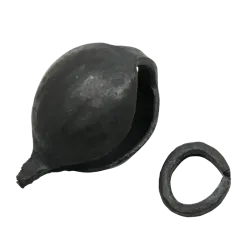
The vibraslap is a percussion instrument whose sound emerges from the collision of metal and plastic components rather than from a single resonating body. A strike on the metal ball triggers vibrations that travel through the instrument's structure, producing a distinctive rattling cascade. This modern version represents a significant departure from the instrument's historical form, which relied on animal bone and loose teeth to generate its characteristic sound.
Origins and historical development
The vibraslap's earliest known design used the jaw bones of donkeys, with the teeth left loose inside the bone structure. When struck, these teeth would rattle against the bone, creating the percussive effect. The transition to modern materials—plastic and steel—preserved the acoustic principle while eliminating dependence on a natural material that required specific sourcing and preparation. This shift made the instrument more consistent, durable, and accessible to musicians worldwide.
Construction and sound characteristics
The metal and plastic construction of this vibraslap creates a bright, sustained rattling sound when struck. The metal ball serves as the striking surface and the primary vibration source, while the plastic resonance chamber amplifies and prolongs the sound. A single firm impact on the ball is sufficient to initiate the full acoustic response, making the instrument straightforward to operate despite the complexity of its internal mechanics.
Playing and applications
Playing the vibraslap requires only a direct strike to the metal ball. The intensity of the strike determines the volume and duration of the rattle. This simplicity in execution makes it accessible to players of varying experience levels, while the characteristic sound lends itself to many musical contexts. The instrument's percussive qualities have established it as a fixture in contemporary music production and ensemble settings where sharp, defined rhythmic textures are desired.
What's included
The vibraslap arrives as a complete, ready-to-play instrument requiring no assembly or additional components.
The vibraslap occupies a distinct place in modern percussion practice, valued for its reliability and the clarity of its acoustic signature across diverse musical traditions.
Vibraslap Metal & Plastic — A modern percussion instrument that produces the characteristic cascading clicking sound that has become essential in Latin arrangements, funk and cinematic sound effects. Composed of a metal ball fixed to a stem that transmits vibrations to a plastic resonance chamber, it creates this distinctive striking noise with each strike. Simple to play yet rich in sonic possibilities, it adapts equally well to world music ensembles and contemporary composition contexts. Manufactured by Clemens Voigt & Sven Otto, this 32 cm instrument weighs 230 grammes. An authentic percussive voice, accessible to all musicians.
| Origin | India |
|---|---|
| Weight | 0,23 kg |
| Dimensions | 32,0 cm |
| Materials | Plastic - Steel |
⚠Caution: Not suitable for children under 3 years. Please supervise older children. Beware of swallowing small parts, strangulation, material allergies, sharp edges and points! Use only for sound generation. No liability for improper use.
✦Care: Extreme temperature fluctuations, humidity and direct sunlight can affect the lifespan. Please store in balanced humidity to prevent material changes, mold and corrosion. Remove dirt with a damp cloth. Dry after cleaning and each use.
♻Disposal: Please contact your local waste disposal authority for information on environmentally sound disposal!
Vibraslap Metal & Plastic
The vibraslap is a percussion instrument whose sound emerges from the collision of metal and plastic components rather than from a single resonating body. A strike on the metal ball triggers vibrations that travel through the instrument's structure, producing a distinctive rattling cascade. This modern version represents a significant departure from the instrument's historical form, which relied on animal bone and loose teeth to generate its characteristic sound.
Origins and historical development
The vibraslap's earliest known design used the jaw bones of donkeys, with the teeth left loose inside the bone structure. When struck, these teeth would rattle against the bone, creating the percussive effect. The transition to modern materials—plastic and steel—preserved the acoustic principle while eliminating dependence on a natural material that required specific sourcing and preparation. This shift made the instrument more consistent, durable, and accessible to musicians worldwide.
Construction and sound characteristics
The metal and plastic construction of this vibraslap creates a bright, sustained rattling sound when struck. The metal ball serves as the striking surface and the primary vibration source, while the plastic resonance chamber amplifies and prolongs the sound. A single firm impact on the ball is sufficient to initiate the full acoustic response, making the instrument straightforward to operate despite the complexity of its internal mechanics.
Playing and applications
Playing the vibraslap requires only a direct strike to the metal ball. The intensity of the strike determines the volume and duration of the rattle. This simplicity in execution makes it accessible to players of varying experience levels, while the characteristic sound lends itself to many musical contexts. The instrument's percussive qualities have established it as a fixture in contemporary music production and ensemble settings where sharp, defined rhythmic textures are desired.
What's included
The vibraslap arrives as a complete, ready-to-play instrument requiring no assembly or additional components.
The vibraslap occupies a distinct place in modern percussion practice, valued for its reliability and the clarity of its acoustic signature across diverse musical traditions.
Your review appreciation cannot be sent
Report comment
Report sent
Your report cannot be sent
Write your review
Review sent
Your review cannot be sent