Water Buffalo Bugle Polished
Polished Water Buffalo Horn
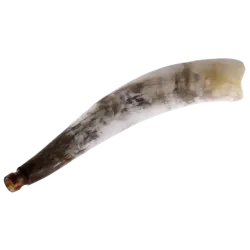
A signalling instrument carved from water buffalo horn and finished to a high polish, this horn produces a powerful, far-carrying sound. The material itself — dense and naturally resonant — is the source of its acoustic strength; the polishing process reveals the horn's structural clarity and optimizes its acoustic properties.
Sound and Playing Technique
The horn is sounded by vibrating the lips against the mouthpiece, a technique shared with brass instruments. This produces a distinctive timbre that bridges animal call and human instrument — penetrating enough to travel across significant distance without amplification.
Historical and Contemporary Uses
Water buffalo horn horns have served as signalling devices across Southeast Asia, used to alert settlements and relay messages before modern communication. Today the instrument appears in world music ensembles, historical reenactments, and theatrical productions where its acoustic character and cultural provenance add authenticity and presence.
Construction and Materials
Crafted from horn — a material prized for its density and natural acoustic properties — the instrument is shaped and finished to a smooth polish. This preparation enhances both the visual clarity of the material and the consistency of the sound it produces.
Getting Started
The technique is accessible to players without prior brass experience, though familiarity with embouchure control (the positioning and tension of the lips) accelerates progress. The horn's loudness means it projects well in ensemble settings and outdoor contexts where projection is valued.
The water buffalo horn remains a functional tool within the signalling traditions of Southeast Asia, and a tangible connection to pre-electronic methods of long-distance communication.
Water Buffalo Bugle Polished — An ancestral signalling instrument originating from South-East Asia, carefully polished to reveal its natural beauty and optimise its acoustic qualities. This horn produces a powerful and carrying sound, capable of travelling long distances — formerly used to alert villages and transmit messages, it finds its place today in world music ensembles, historical reconstructions and theatrical productions. Accessible to beginners, the technique is similar to that of brass instruments: a vibration of the lips against the mouthpiece produces this unique timbre, halfway between the trumpet and the animal call. A living testimony to traditional communication methods, bearing a history and singular character.
| Origin | Vietnam |
|---|---|
| Weight | 0,60 kg |
| Dimensions | 45,0 × 10,0 × 7,0 cm |
| Materials | Horn |
⚠Caution: Not suitable for children under 3 years. Please supervise older children. Beware of swallowing small parts, strangulation, material allergies, sharp edges and points! Use only for sound generation. No liability for improper use.
✦Care: Extreme temperature fluctuations, humidity and direct sunlight can affect the lifespan. Please store in balanced humidity to prevent material changes, mold and corrosion. Remove dirt with a damp cloth. Dry after cleaning and each use.
♻Disposal: Please contact your local waste disposal authority for information on environmentally sound disposal!
Polished Water Buffalo Horn
A signalling instrument carved from water buffalo horn and finished to a high polish, this horn produces a powerful, far-carrying sound. The material itself — dense and naturally resonant — is the source of its acoustic strength; the polishing process reveals the horn's structural clarity and optimizes its acoustic properties.
Sound and Playing Technique
The horn is sounded by vibrating the lips against the mouthpiece, a technique shared with brass instruments. This produces a distinctive timbre that bridges animal call and human instrument — penetrating enough to travel across significant distance without amplification.
Historical and Contemporary Uses
Water buffalo horn horns have served as signalling devices across Southeast Asia, used to alert settlements and relay messages before modern communication. Today the instrument appears in world music ensembles, historical reenactments, and theatrical productions where its acoustic character and cultural provenance add authenticity and presence.
Construction and Materials
Crafted from horn — a material prized for its density and natural acoustic properties — the instrument is shaped and finished to a smooth polish. This preparation enhances both the visual clarity of the material and the consistency of the sound it produces.
Getting Started
The technique is accessible to players without prior brass experience, though familiarity with embouchure control (the positioning and tension of the lips) accelerates progress. The horn's loudness means it projects well in ensemble settings and outdoor contexts where projection is valued.
The water buffalo horn remains a functional tool within the signalling traditions of Southeast Asia, and a tangible connection to pre-electronic methods of long-distance communication.
Your review appreciation cannot be sent
Report comment
Report sent
Your report cannot be sent
Write your review
Review sent
Your review cannot be sent