Calabash Rattle

Price: €10.72
SKU RKG-12M Category Shakers & Rattles

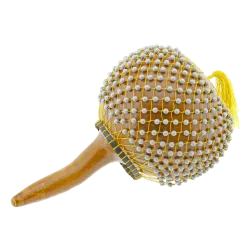
Calabash Rattle with Braided Bast Net

The calabash rattle is a percussion instrument constructed from a dried bottle gourd, sourced from Ghana and wrapped in a braided covering made from natural bast fibres. The gourd functions as a resonating chamber, and the internal contents—seeds or small stones—create the percussive sound when the instrument is shaken.

Sound Character and Tonal Range

The acoustic properties of this rattle vary according to size. Larger examples produce a heavier, darker tone with a soft quality that carries an almost melancholic character. Smaller versions generate a brighter, more cheerful sound with greater definition and clarity. Both sizes respond directly to the player's gesture: a light shake produces a gentler texture, while more vigorous movement generates sharper, more pronounced articulation.

Construction and Materials

The instrument is built around a naturally dried gourd that serves as both structural shell and acoustic body. The braided bast net covering the gourd is woven in various colour combinations, creating visual variety while serving a functional purpose—the net contains the internal materials and allows sound to project outward. This combination of organic materials produces a warm, organic sonic quality that distinguishes the calabash rattle from synthetic percussion alternatives.

Playing and Musical Use

The rattle accommodates both subtle wrist movements and deliberate accent strokes, making it accessible to players at any experience level. The flexible handle allows for comfortable grip and control during extended play. The instrument responds naturally to rhythmic accompaniment in various musical contexts, from work rhythms and ceremonial settings to dance music, where it has been employed across generations of African and South American musical traditions.

Visual Characteristics

The braided bast net displays different colour combinations from piece to piece, ensuring that each rattle is visually distinct. This natural variation in the covering reflects the handmade nature of the construction process and adds individual character to the finished instrument.

The calabash rattle remains a foundational rhythm instrument across African and South American musical cultures, valued for both its sonic integrity and its connection to centuries of percussive practice.

Price: €10.72
SKU RKG-12M Category Shakers & Rattles

Hochet en calebasse — A gourd shaker rooted in African and South American tradition, handcrafted from a hollowed calabash filled with seeds or stones and bound with woven raphia. When shaken, it produces a warm, organic rattle that accompanies rhythmic work, ceremony, and dance across generations. Medium-sized with a flexible handle, it responds equally to subtle wrist rolls and purposeful accents, making it accessible to beginners while offering depth for experienced players. Connect to centuries of percussion heritage with an instrument that sounds like no electronic device can.

As a handmade item, no two pieces are exactly alike. The product shown is an illustrative example — minor variations in shape, colour and design are part of what makes each instrument unique.
Size Medium
Audio Samples
Calabash Rattle - Small
Calabash Rattle - Medium
Origin Ghana
Materials Gourd - raffia

Caution: Not suitable for children under 3 years. Please supervise older children. Beware of swallowing small parts, strangulation, material allergies, sharp edges and points! Use only for sound generation. No liability for improper use.

Care: Extreme temperature fluctuations, humidity and direct sunlight can affect the lifespan. Please store in balanced humidity to prevent material changes, mold and corrosion. Remove dirt with a damp cloth. Dry after cleaning and each use.

Disposal: Please contact your local waste disposal authority for information on environmentally sound disposal!

Calabash Rattle with Braided Bast Net

The calabash rattle is a percussion instrument constructed from a dried bottle gourd, sourced from Ghana and wrapped in a braided covering made from natural bast fibres. The gourd functions as a resonating chamber, and the internal contents—seeds or small stones—create the percussive sound when the instrument is shaken.

Sound Character and Tonal Range

The acoustic properties of this rattle vary according to size. Larger examples produce a heavier, darker tone with a soft quality that carries an almost melancholic character. Smaller versions generate a brighter, more cheerful sound with greater definition and clarity. Both sizes respond directly to the player's gesture: a light shake produces a gentler texture, while more vigorous movement generates sharper, more pronounced articulation.

Construction and Materials

The instrument is built around a naturally dried gourd that serves as both structural shell and acoustic body. The braided bast net covering the gourd is woven in various colour combinations, creating visual variety while serving a functional purpose—the net contains the internal materials and allows sound to project outward. This combination of organic materials produces a warm, organic sonic quality that distinguishes the calabash rattle from synthetic percussion alternatives.

Playing and Musical Use

The rattle accommodates both subtle wrist movements and deliberate accent strokes, making it accessible to players at any experience level. The flexible handle allows for comfortable grip and control during extended play. The instrument responds naturally to rhythmic accompaniment in various musical contexts, from work rhythms and ceremonial settings to dance music, where it has been employed across generations of African and South American musical traditions.

Visual Characteristics

The braided bast net displays different colour combinations from piece to piece, ensuring that each rattle is visually distinct. This natural variation in the covering reflects the handmade nature of the construction process and adds individual character to the finished instrument.

The calabash rattle remains a foundational rhythm instrument across African and South American musical cultures, valued for both its sonic integrity and its connection to centuries of percussive practice.

Comments (0)
No customer reviews for the moment.

You may also like