Duduk Piccolo E with Ghamish
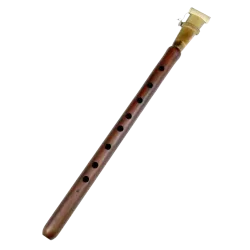
The Duduk Piccolo E is a smaller member of the Armenian Duduk family, pitched higher than the standard Tenor A. Crafted from apricot wood, it produces a lighter, more delicate voice while retaining the warm, woody character that defines the instrument across all its sizes. This version expands the sonic palette available to ensembles and composers seeking tonal variety within the Duduk range.
Construction and Sound
Like all Duduks, the Piccolo E is built from apricot wood, a material chosen for its acoustic properties and workability. The higher pitch of this model results from its smaller bore and length relative to the Tenor A, producing a voice suited to different musical contexts and arrangements. The wood's natural density contributes to the instrument's characteristic warm resonance.
The Ghamish Reed
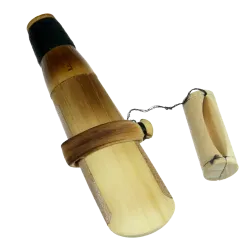
The Ghamish—the double-reed mouthpiece—is integral to the Duduk's sound. The Ghamish for the Piccolo E is proportioned to match this instrument's pitch and bore. The reed is notably longer and broader than those found on most other double-reed instruments, a structural feature that allows the Duduk to produce its smooth, singing tone. Each Duduk pitch requires its own appropriately sized Ghamish; the letter or marking on the reed is the maker's signature, not a tuning indicator.
The Ghamish supplied with this instrument is handcrafted over a two-week period without cracking, a labour-intensive process that ensures stability and playability.
Preparing and Playing the Ghamish
Before playing, the Ghamish requires gentle warming and moistening. Hold the reed loosely between your lips—slightly lower than the playing position—with a relaxed grip, and wet it lightly. The Ghamish will gradually open, often producing a slight cracking sound that is normal and harmless. To further warm it, reverse the reed, take the wrapped end into your mouth, and breathe calmly for several minutes. This gradual process supplies heat and moisture evenly, preparing the reed for play.
Do not immerse the Ghamish in water. Rapid water absorption causes the material to open too quickly, leading to permanent cracking and loss of playability. For storage and transport, a basic eyeglass hard case with drilled ventilation holes provides secure protection and proper air circulation.
During performance, use the clamp fitted to the Ghamish to fine-tune the sound through adjustments in pressure and embouchure control. Both the Duduk body and the Ghamish require time to reach their full sonic potential as they warm and absorb moisture during play.
What's Included
- One Duduk Piccolo E
- One Ghamish reed matched to the instrument's pitch
- Small cleaning cloth
Musical Applications
The Piccolo E's higher pitch makes it valuable for ensemble arrangements where tonal contrast is desired, for film and theatrical scoring, and for world music contexts where multiple Duduk voices are employed. Its lighter voice complements lower-pitched Duduks and blends with other wind and string instruments across diverse musical traditions.
The Duduk remains central to Armenian musical heritage and is played across the broader Middle Eastern and world music communities.
Duduk Piccolo E with Ghamish — Traditional Armenian instrument handcrafted in apricot wood by master maker Karen Hakobyan, offering a higher and more delicate voice than the standard Tenor A. Supplied with an adjustable reed Ghamish, this instrument produces a soft and melancholic sound ideal for ensemble arrangements, film compositions and world music contexts. A sonic speciality for musicians seeking an alternative texture within the duduk family.
| Origin | Armenia |
|---|---|
| Materials | Apricot wood |
⚠Caution: Not suitable for children under 3 years. Please supervise older children. Beware of swallowing small parts, strangulation, material allergies, sharp edges and points! Use only for sound generation. No liability for improper use.
✦Care: Extreme temperature fluctuations, humidity and direct sunlight can affect the lifespan. Please store in balanced humidity to prevent material changes, mold and corrosion. Remove dirt with a damp cloth. Dry after cleaning and each use.
♻Disposal: Please contact your local waste disposal authority for information on environmentally sound disposal!
Duduk Piccolo E with Ghamish
The Duduk Piccolo E is a smaller member of the Armenian Duduk family, pitched higher than the standard Tenor A. Crafted from apricot wood, it produces a lighter, more delicate voice while retaining the warm, woody character that defines the instrument across all its sizes. This version expands the sonic palette available to ensembles and composers seeking tonal variety within the Duduk range.
Construction and Sound
Like all Duduks, the Piccolo E is built from apricot wood, a material chosen for its acoustic properties and workability. The higher pitch of this model results from its smaller bore and length relative to the Tenor A, producing a voice suited to different musical contexts and arrangements. The wood's natural density contributes to the instrument's characteristic warm resonance.
The Ghamish Reed
The Ghamish—the double-reed mouthpiece—is integral to the Duduk's sound. The Ghamish for the Piccolo E is proportioned to match this instrument's pitch and bore. The reed is notably longer and broader than those found on most other double-reed instruments, a structural feature that allows the Duduk to produce its smooth, singing tone. Each Duduk pitch requires its own appropriately sized Ghamish; the letter or marking on the reed is the maker's signature, not a tuning indicator.
The Ghamish supplied with this instrument is handcrafted over a two-week period without cracking, a labour-intensive process that ensures stability and playability.
Preparing and Playing the Ghamish
Before playing, the Ghamish requires gentle warming and moistening. Hold the reed loosely between your lips—slightly lower than the playing position—with a relaxed grip, and wet it lightly. The Ghamish will gradually open, often producing a slight cracking sound that is normal and harmless. To further warm it, reverse the reed, take the wrapped end into your mouth, and breathe calmly for several minutes. This gradual process supplies heat and moisture evenly, preparing the reed for play.
Do not immerse the Ghamish in water. Rapid water absorption causes the material to open too quickly, leading to permanent cracking and loss of playability. For storage and transport, a basic eyeglass hard case with drilled ventilation holes provides secure protection and proper air circulation.
During performance, use the clamp fitted to the Ghamish to fine-tune the sound through adjustments in pressure and embouchure control. Both the Duduk body and the Ghamish require time to reach their full sonic potential as they warm and absorb moisture during play.
What's Included
- One Duduk Piccolo E
- One Ghamish reed matched to the instrument's pitch
- Small cleaning cloth
Musical Applications
The Piccolo E's higher pitch makes it valuable for ensemble arrangements where tonal contrast is desired, for film and theatrical scoring, and for world music contexts where multiple Duduk voices are employed. Its lighter voice complements lower-pitched Duduks and blends with other wind and string instruments across diverse musical traditions.
The Duduk remains central to Armenian musical heritage and is played across the broader Middle Eastern and world music communities.
Your review appreciation cannot be sent
Report comment
Report sent
Your report cannot be sent
Write your review
Review sent
Your review cannot be sent